Public Libraries as our High Street Anchors
July 21, 2025

At last month’s Libraries Connected seminar, a talk from Ian Harvey from the Institute of Place Management (IPM) highlighted just how critical it is to recognise the huge significance of public libraries. They are a key part of our social infrastructure and invaluable as local and unique institutions. They belong to our towns, cities and their citizens, and are integral to the vitality and regeneration of these places.
It’s a topic that Lorensbergs studied closely in 2021 with case studies from six library authorities. This was in the earlier days of social and economic recovery from Covid. What libraries were doing then was both critical and timely to support this recovery. But it was still very much a continuation of their usual role – it just became all the more apparent and recognised when thrown into sharp relief by the crisis. Indeed, the case studies have stood the test of time and are very much worth revisiting as we reflect on what it means to describe libraries as our town centre anchors.
From the six case studies, here are the key aspects that characterise libraries in this way:
The authorities participating in our research had further ambitions and plans to develop their presence and role. Four years on, it’s interesting to revisit these plans and see the progress made.
Bolton Libraries was planning a large scale refurbishment of their central library. This opened in early 2024 after undergoing a restoration and refurbishment that adapted the building to meet changing requirements and wider needs with new creative and cultural spaces.
Brent Libraries was aiming to increase the capacity of its community space for cultural and social purposes. Its reopening of Wembley Library in December 2024 expanded the library space with a new resident hub and dedicated customer service area, digital zone and separate rooms, plus a new, purpose-built children’s library.
At Fife Libraries, flexible space and furniture were attracting the use of different groups. Regular events were leading to return visits and the forging of new social bonds. Extra events have since helped grow footfall further.
Hertfordshire Libraries actively seeks opportunities to relocate libraries to more central locations. This has progressed with Hatfield and Ware libraries both moving to more prominent positions, supporting their role as hubs for social and community cohesion. Furthermore, the library authority’s CreatorSpaces have grown with new facilities at Hatfield, Hitchin and Welwyn Garden City and a new one planned using LIF (Libraries Improvement Fund) funding from ACE (Arts Council England). In addition, the CreatorSpace Out of the Box offer is proving popular in smaller libraries.
Gloucestershire Libraries had positioned their sites as accessible, central spaces and attractive hubs for visiting and interacting. Their Growth Hubs had already been at the heart of regional business growth. Plans for 6 new innovation labs have been quickly realised, providing equipment including 3D printing and media software. It enables users to learn new skills. Small and new businesses can access and experiment with resources that would otherwise be difficult to afford. They are now working towards the relocation and GCC investment in Gloucester new library in a prime city centre regeneration location.
At North Somerset Libraries, self-service has supported resuming their events programme and they have been able to start offering additional events via new partnerships. They have long worked with the economic team to help boost local employment and develop jobseeking and IT skills. This partnership has gone from strength to strength with a range of related services and activities including regular employability sessions and an Employment and Skills Hub. Digi Buddies and IT Gadget Support sessions are regularly available. A partnership with Public Health delivers community wellbeing sessions, including painting and aromatherapy. In addition, social connections are supported via various clubs, e.g. involving jigsaws, arts and crafts.

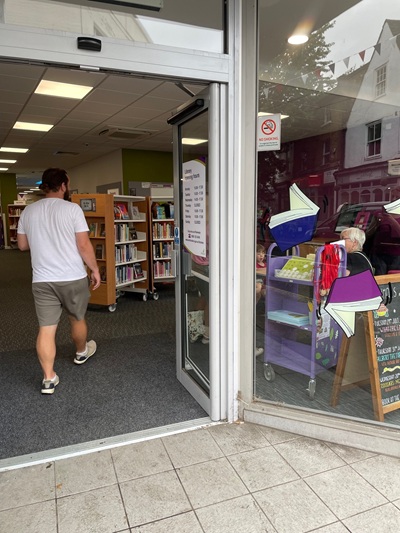

Above: Libraries are popular high street destinations – the new Ware Library from Hertfordshire Libraries’ case study.
So library ambitions are being realised. In fact across all authorities, around 50% are seeing library footfall and event attendance increase due to a range of factors (Netloan Public Library Survey 2024). Extra events, reopening refurbished sites, publicity, extended self -service hours, partnership services inclusion, and face-to-face support for council services are all contributing to this growth.
There’s so much more they are able to do when given the necessary recognition and funding. It’s important that this happens when they contribute so much to societal resilience.
Going back to the IPM talk, there’s a key takeaway that will help pave the way here. It was emphasised that you cannot plan separately for health or education or libraries on either a local or national level. For it to be effective, government planning has to combine and coordinate all parts of this critical social infrastructure. Clearly it’s time to boost our resilience and incorporate greater library potential in our plans for a better future.
Resilient Places – Ian Harvey, Institute of Place Management
– please contact ipm@mmu.ac.uk to request a copy.
Reviving our High Streets: The Role of Libraries – Lorensbergs
Public Libraries 2024: Netloan Survey Results – Lorensbergs