A Postcard from IFLA WLIC, Dublin 2022
It was an amazing experience to attend the IFLA WLIC (World Library and Information Congress) in Dublin last month. Taking place for the 87th time this year, WLIC has long been established as an important meeting for librarians from every corner of the globe. With an interesting and diverse agenda, WLIC attendees have the opportunity to meet thousands of librarians from over 100 countries in the space of a few days.
The programme together with a convivial atmosphere makes the sharing of ideas and experiences both exciting and memorable. After a two year delay delegates were excited to be back in person at the conference. The overall theme was ‘Inspire, Engage, Enable, Connect’. The issues being addressed for public libraries were certainly thought provoking. Here are some of our highlights from the sessions we attended.
Democracy and Libraries
The role of libraries in supporting and preserving democratic society was a key theme. Speaker Ton van Vlimmeren President of EBLIDA (European Bureau of Library, Information and Documentation Associations), described the context as this: for 15 years running there has been less human freedom across the world. According to the Human Freedom Index, 83% are living in jurisdictions that have seen a deterioration in freedom across a range of laws, regulations and other related indicators.
WLIC session The Impact of Libraries in a Democratic Society, with slides from EBLIDA and National Library Board, Singapore.
The session on The Impact of Libraries in a Democratic Society explored this issue from the perspective of algorithmic based news distribution. Simply put, democracy is compromised by the growth in fake news and propaganda. When so many of us are in danger of living in algorithmic fed information bubbles, libraries play an important role in educating how to break free of them. Fragmented and commercially driven news sources can polarise and divide societies, but libraries can help to regain common ground for informed debate.
There were some great examples of how they are equipping their users with the awareness to challenge the echo chambers and filter bubbles that threaten the basis of democratic society. Toronto Public Library’s “Get out of your bubble” series runs events and podcasts to address the issue. National Library Board Singapore discussed how libraries can challenge the confirmation bias bubbles by virtue of their wide information sources and power of curation. Their “Read to the Sure” programme helps educate on how to read widely then go deeper to avoid misinformation and bias.
An Updated Manifesto for Public Libraries
Barbara Lison President-elect of IFLA, introduces the updated IFLA UNESCO Manifesto
It was interesting reviewing the IFLA UNESCO manifesto in this light. It declares public libraries as “providing access to and enabling the creation and sharing of knowledge of all sorts, including scientific and local knowledge without commercial, technological or legal barriers.” It’s been updated this year to reflect libraries’ contribution to their communities and how they support decision making and participation. It also allows for greater consideration of digital technology and literacy and scientific advancement. These changes and what the manifesto represents led to illuminating discussion at WLIC. It’s already a foundation piece for library advocacy and promotion. We concluded that it reinforces and reflects what libraries do. However, they need to be skilled at interpreting it for their specific circumstances and needs, and generating fresh ideas on how to apply it.
Localisation and Libraries
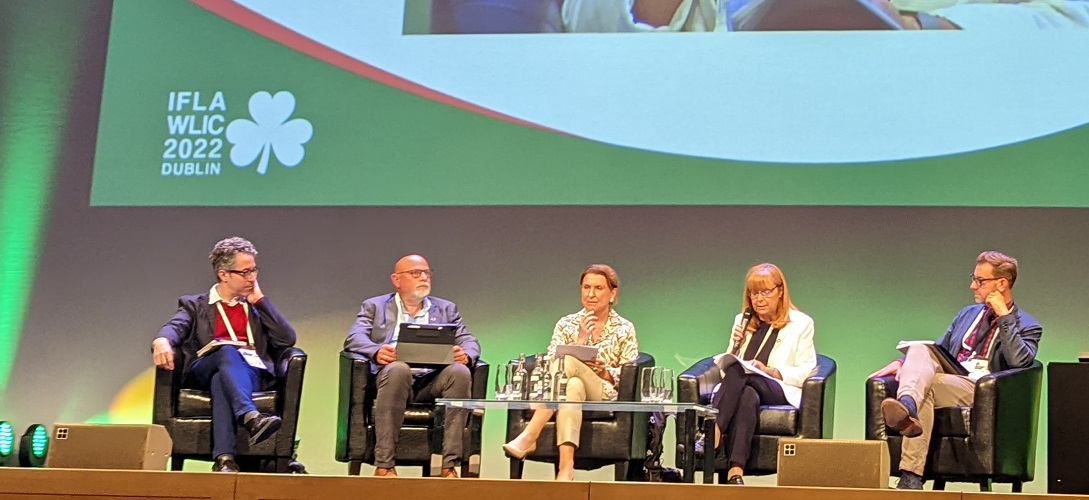
A panel session that explored the practicalities of providing services that reflect and meet local needs was the Local Government Session on Localisation and Libraries in the Wake of COVID-19. In contrast to the national and international perspective IFLA often takes, this session explored the local agenda. As Stuart Hamilton, Libraries Development for the Local Government Management Agency in Ireland explained it, localisation is “where the rubber hits the road”, in other words it’s where the policies and strategies are implemented and the impact is felt by the community.
Success is dependent on mutual understanding, shared objectives and close ways of working. This very much reflects our 2021 survey findings on successful partnership working in local government. What libraries are able to achieve and the speed at which they can succeed was demonstrated brilliantly in 2020 as services were swiftly adapted for online reach in response to Covid. Many onsite services including computers were also successfully adapted for safer use, and Wi-Fi continued to serve all in its reach beyond library walls.
There were examples of how at a national level libraries were promoted as a source of support and assistance during the pandemic. It was concluded that the work of libraries across the globe at this time is further evidence of their extraordinary value and agility to understand and respond to their communities’ needs and that this is increasingly understood by national policy makers.
Inspire, Engage, Enable, Connect
Overall what struck us most from attending WLIC is this: despite the geographical differences, there is a significant universality between libraries in shared experience and overarching objectives. Time and again the importance of the library’s role in supporting digital inclusion and IT literacy was expressed. This is understandable as librarianship is all about connecting people to information in whatever form it takes. So the ability to access digital equipment carries huge significance when providing services, whether it’s for people seeking new opportunities, those requiring digital skills development, or simply those who without the library are digitally excluded and need access to their email.
In this digital age, the importance of the library in helping users access and navigate the online world is inescapable wherever you may be. It’s the case for individual users, for their communities and indeed for democratic society as a whole.
Discover More